THE PROJECT
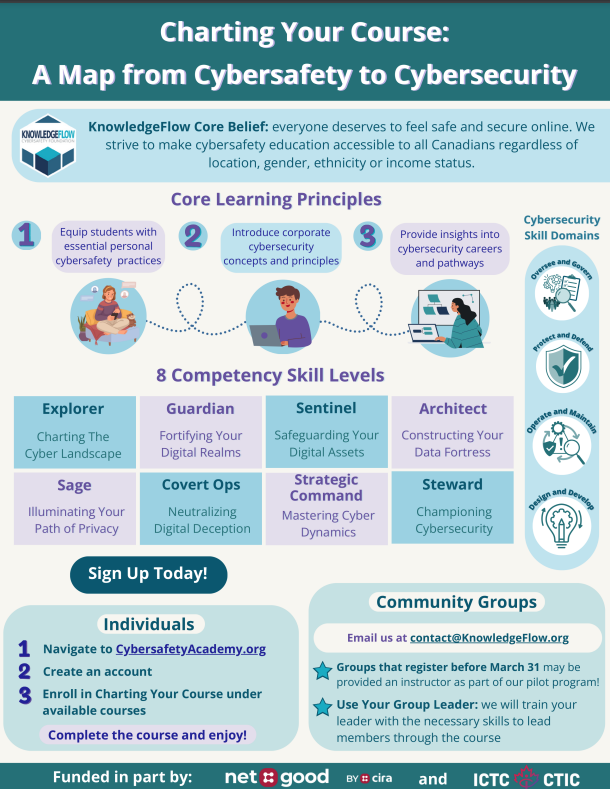
KnowledgeFlow Cybersafety Foundation Canada is the country’s only non-profit dedicated exclusively to cybersafety and digital skills education and awareness. Their mission is to make Canadians “unhackable” by providing access to educational resources regardless of geographic, economic or social circumstances—particularly for BIPOC youth, seniors and new Canadians. In the face of ever-increasing cyber threats, this project piloted Charting Your Course: A Map from Cybersafety to Cybersecurity, an educational solution to Canada’s growing cybersecurity skills shortage. The course equips students in grades 9-12 with critical cybersafety skills with the ultimate goal of exposing them to cybersecurity career pathways.
Debra Popa, Executive Director, noted this program is specifically aimed at high school students because they are especially vulnerable to cybersecurity threats. “For teens, one of the biggest online threats is sextortion, which we’ve seen end in devastating outcomes like suicide,” she explained. “It’s getting much harder to detect scams and impersonations because they’re so sophisticated now, especially with AI.” And with the Canadian Anti-Fraud Centre reporting a staggering $530 million in victim losses due to cybercrime in 2022, educating teens about cyber threats is particularly timely. Debra noted that teens are often a target for cybercrimes like identify theft because they still have clean credit records. “My personal mission is to make sure teens know in advance about these crimes so they can better protect themselves,” she said.
KnowledgeFlow recruited over 400 students to participate in the pilot through partnerships with community organizations in Ontario, Nova Scotia and British Columbia, including OneNorthEnd, SistersInSync, the Halifax Public Library and Youth in Policing Initiatives. Facilitators, often teachers, led both in-person and virtual sessions that covered topics like securing devices, protecting personal files, recognizing scams and addressing cyberbullying. The course has interactive and dynamic content to keep students engaged, including games like “What’s the Harm” that illustrate the potential consequences of various online behaviours, encouraging teens to think critically about their actions online.
What makes Charting Your Course really stand out among online safety initiatives is the component that introduces teens to cybersecurity as a career. The goal of KnowledgeFlow is to reach students well before university or college, so they are ready to choose a path that can shape a career in cybersecurity. Debra explained, “A lot of girls stop studying STEM in high school, and a lot of teens don’t even understand what cybersecurity as a career entails.” Teaching personal cybersafety is KnowledgeFlow’s gateway to helping teens see how these same issues play out at a larger scale in banks, online stores and hospitals for example—demonstrating how that knowledge is directly applicable to future job opportunities. The course introduces participants to the Canadian cyber security skills framework and has an interactive career map guiding students through the various ways they can enter the cybersecurity field.
COMMUNITY IMPACT
Participants were overwhelmingly positive in their feedback:
- “I feel that this course pushed and allowed me to learn more about my online safety, which I would have otherwise never learned, because even though at school they kind of teach it, but not to this level.”
- “The practical skills I learned have made me more cautious online, and I’m now excited to build a career in this field. I’ve also shared what I’ve learned with others, helping them improve their own online security.”
- “Because of this course, I now know how to protect myself better and will be more careful when talking to people on the internet.”
90% of participants reported an increased awareness of pathways into the cybersecurity field, and 91% said they learned new information about corporate cybersecurity concepts. Charting Your Course is now a regular part of KnowledgeFlow’s online safety programming.
Students appreciated the interactive elements of the course, such as the quizzes and games, which made learning more engaging. Facilitators also reported that students were highly attentive and engaged during in-person sessions, especially when discussing real-world online risks and career opportunities. Debra expects that families and friends of course participants will also benefit from improved online safety through knowledge sharing, creating a broader community impact.
For Debra, one of the most significant learnings of the project is that teens are motivated to adopt safe online behaviours as long as they can still use their devices; cutting them off is not a solution. She explained, “If potential online harms are explained in realistic yet empowering terms, they are very much in support of changing their behaviours.”
KnowledgeFlow plans to continue promoting the course during Cybersafety Awareness Month and National CyberDay, and the course will be offered in both online and in-person formats for years to come, contributing to a more secure digital landscape for all Canadians.
RELATED LINKS
- Charting Your Course: A Map from Cybersafety to Cybersecurity: https://knowledgeflow.org/initiative/charting-your-couse-a-map-from-cybersafety-to-cybersecurity/