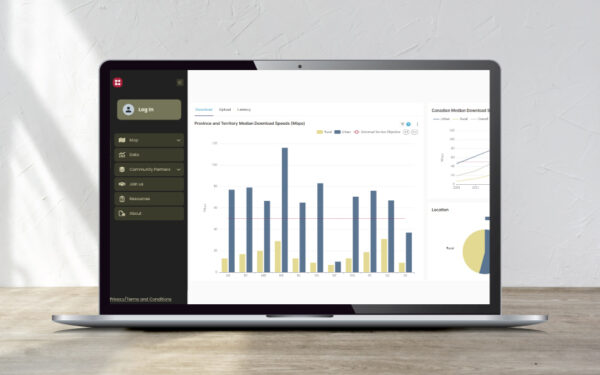
Over a decade of CIRA’s Internet Performance Test (IPT) results tells a clear story: Canadian connections are much faster than they were in 2015, but the rural /urban divide has not disappeared.
Use the interactive speed gauges to the left to discover average (median) download and upload speeds by year across the country. This is a summary of all tests run on the IPT platform each calendar year.
Faster speeds especially since 2021
- Download: in 2015, median Canadian download speeds were just under 12 Mbps. By 2024 they reached 92 Mbps. Progress stalled for several years, then soared from 2021 onward.
- Upload: first measured below 3 Mbps, median uploads climbed to 26.6 Mbps by 2024
- Downloads topped the CRTC’s 50 Mbps target in 2022; uploads cleared the 10 Mbps mark in 2023, meeting Canada’s broadband standard often referred to as 50/10
Why are the speeds increasing, especially after 2021?
- Internet Service Providers and other telecommunications, cable and phone companies have poured investments into their network infrastructure, so customers gain access to better performing and more reliable networks.
-
Public investment
-
Connect to Innovate (2016) – $500 M for rural fibre backbones.
-
CRTC Broadband Fund (2019) – $752 M for fibre and wireless upgrades in 290 communities.
-
Universal Broadband Fund (2020) – $3.2 B to push 50/10 to 98 per cent of Canadians by 2026 (remaining 2 per cent by 2030).
-
- New technologies: Low-Earth-Orbit (LEO) satellites launched nationally in 2021, giving farms and northern hamlets a new high-speed option. Around the same time, 5G fixed-wireless home internet with speeds up to 500 Mbps arrived in small towns, starting on the East Coast.
- Community & private-equity models: municipal and indigenous networks, buoyed by grants, began co-building infrastructure. Stable, utility-style returns plus public funding attracted private-equity deals. CIRA’s own Net Good Grants helped seed smaller community projects.
Does this mean every Canadian now has access to fast and reliable internet service? Things are better, but not quite.
The speed gauges above showed overall national median download and upload speed each year. The area chart below separates the test data in median urban vs. median rural speeds in order to visualize the gap between. Despite the progress, the data for 2024 still shows urban users enjoy roughly twice the download speed and more than triple the upload speed of rural users. Put differently, the gap has narrowed but not closed.
Higher costs per kilometre, low population density and rugged terrain keep infrastructure builds challenging. And while technologies like LEO satellites bridge distance, equipment fees remain a barrier for lower-income households.
The government has set a target date of 2030 for every Canadian to have access to universal service objective targets. Provinces like Ontario have accelerated their timelines even more by providing their own investments. Will we get there? And what is needed to meet these targets?
To get there, government, industry and civil-society partners need to work together!
- Finish the map: according to the CRTC, roughly 5 per cent of Canadian homes, mostly in the far North and rural pockets, still lack access to services that deliver 50/10 service. Targeting the hardest-to-reach locations with fibre transport, upgraded fixed-wireless or subsidized LEO installs is essential as one technology cannot solve the problem alone.
- Beyond 50/10: many households now stream, game and work remotely on multiple devices. For some, 50/10 is plenty; for others gigabit and symmetrical speeds are the new baseline. Flexibility should guide future policy.
- Monitor & publish: tools like the IPT give policymakers a real-world check on whether dollars spent translate into daily-life improvements. Continued open data (like this blog post!) and your participation in running tests, keeps everyone accountable.
Ten years in, Canada’s internet is undeniably faster and performs better. The challenge for the next decade is to ensure everyone enjoys those gains, no matter their location.
This post is the second of a five-part series celebrating a decade of the IPT. In upcoming posts we’ll continue to explore broadband trends, spotlight community success stories and look ahead to the future of internet measurement in Canada.
Jeff is the Internet Performance Test (IPT) Program Manager. The IPT is the most advanced internet quality test in Canada that provides public access to the performance results. Jeff is an avid advocate for how IPT data, maps and reports can help stakeholders identify areas with limited access, improve funding decisions, evaluate the success of funded projects and do so at a high degree of geographic granularity.